Computer Vision in AI: Real-World Applications for Businesses and Developers
Computer Vision in AI: Real-World Applications for Businesses and Developers
Computer Vision in AI is rapidly transforming how we interact with the world, enabling machines to "see" and interpret visual information with remarkable accuracy. This powerful field of artificial intelligence is no longer confined to research labs; it's now a cornerstone for innovation across countless industries. From enhancing operational efficiency to creating entirely new customer experiences, the real-world applications of computer vision are vast and continuously expanding. Both businesses seeking competitive advantages and developers eager to build cutting-edge solutions stand to benefit immensely from understanding this technology.
Key Points:
- Definition: Computer Vision allows AI systems to interpret visual data.
- Impact: Revolutionizes industries from retail to healthcare.
- Benefits: Boosts efficiency, improves safety, and enhances user experience.
- Growth: Driven by advancements in deep learning and data availability.
- Future: Continues to evolve with new applications emerging constantly.
Understanding Computer Vision in AI: A Core Technology
Computer Vision in AI refers to the scientific field where computers are trained to understand and process visual data from the real world. This includes images and videos, much like human eyes and brains do. It involves sophisticated algorithms and deep learning models that enable machines to identify objects, recognize faces, detect anomalies, and even understand complex scenes. The ability of AI vision systems to extract meaningful information from visual inputs is what drives its diverse applications.
The Mechanics of AI Vision Systems
At its core, computer vision relies on machine learning techniques, particularly deep neural networks. These networks are trained on massive datasets of labeled images, learning patterns and features that allow them to make accurate predictions or classifications. For instance, a system might learn to distinguish between a cat and a dog by analyzing millions of animal images. The process typically involves image acquisition, preprocessing, feature extraction, and finally, classification or segmentation. This intricate process allows AI to perform tasks that were once exclusively human domains.
Transforming Industries: Real-World Computer Vision Applications for Businesses
The practical applications of computer vision are reshaping business operations and customer interactions across various sectors. Businesses are leveraging these AI vision systems to automate tasks, gain insights, and improve decision-making. The impact is profound, leading to significant efficiencies and new service offerings.
Enhancing Retail and E-commerce with AI Vision
In retail, computer vision is a game-changer for both brick-and-mortar stores and online platforms. It enables automated inventory management by scanning shelves for stock levels and misplaced items, reducing manual labor and errors. Customer behavior analysis, another key application, uses AI vision to understand shopper movements, dwell times, and product interactions, providing invaluable insights for store layouts and marketing strategies. For e-commerce, visual search capabilities allow customers to find products using images, significantly improving the shopping experience.
Revolutionizing Healthcare through Medical Image Analysis
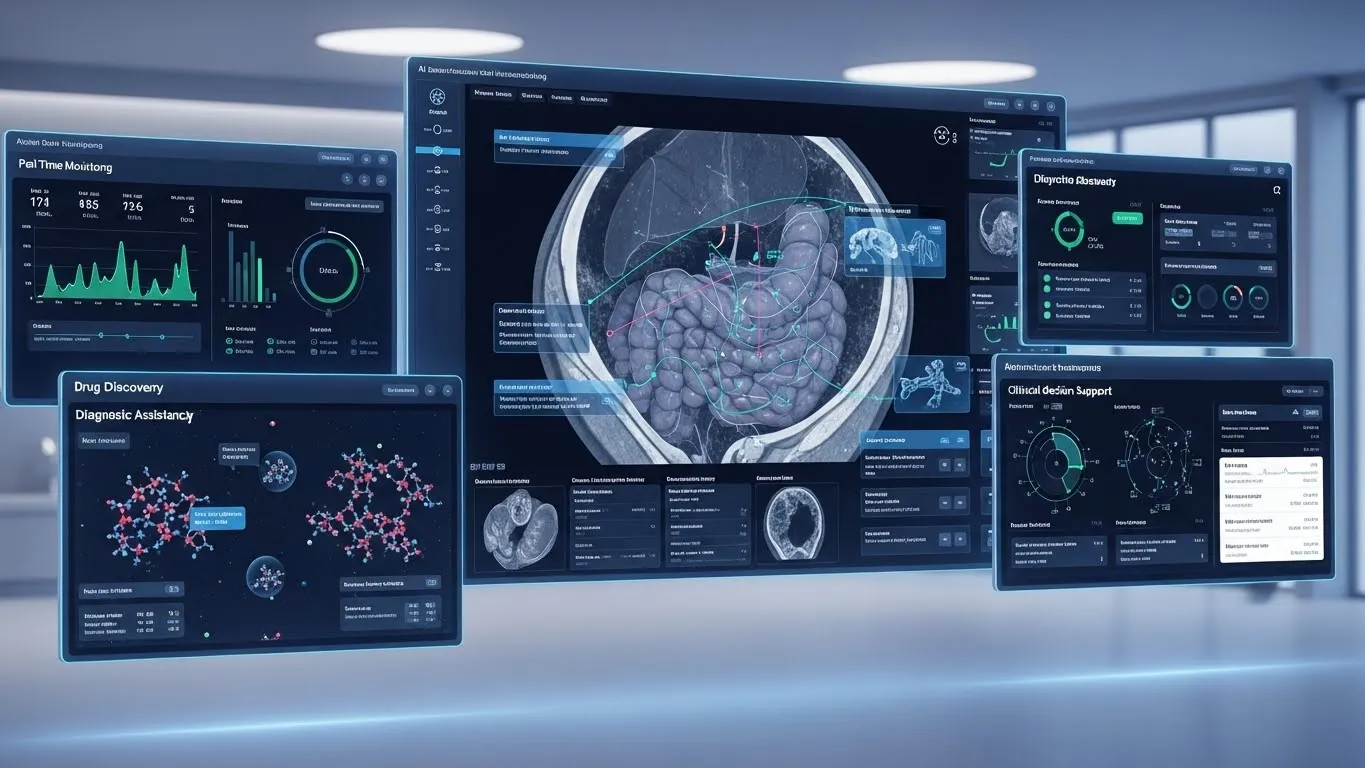
Healthcare is experiencing a significant transformation thanks to computer vision. AI vision systems are now capable of analyzing medical images such as X-rays, MRIs, and CT scans with remarkable precision. This aids in the early detection of diseases like cancer, diabetic retinopathy, and neurological disorders, often identifying subtle patterns that human eyes might miss. Furthermore, computer vision assists surgeons during complex procedures by providing real-time guidance and enhancing accuracy, ultimately leading to better patient outcomes.
Boosting Manufacturing and Quality Control
In manufacturing, computer vision systems are indispensable for ensuring product quality and optimizing production lines. Automated visual inspection systems can detect defects on assembly lines at high speeds, far surpassing human capabilities in consistency and endurance. This includes identifying minuscule flaws in components or verifying correct assembly. Robotic guidance systems, powered by computer vision, enable robots to perform intricate tasks like picking, placing, and welding with greater precision and adaptability, leading to increased efficiency and reduced waste.
Advancing Autonomous Systems and Smart Cities
Computer vision is the "eyes" of autonomous vehicles, allowing them to perceive their surroundings, detect pedestrians, other vehicles, traffic signs, and lane markings. This critical capability is fundamental to the development of self-driving cars and drones. In smart cities, AI vision systems monitor traffic flow, identify parking vacancies, and enhance public safety through intelligent surveillance, contributing to more efficient and secure urban environments. For more insights into smart city technologies, readers can explore related articles on urban innovation.
Empowering Developers: Building with Computer Vision Technologies
Developers are at the forefront of creating these transformative computer vision solutions. Understanding the tools, frameworks, and challenges is crucial for building robust and effective AI vision systems. The field offers immense opportunities for innovation and problem-solving.
Key Tools and Frameworks for Computer Vision Development
The ecosystem for computer vision development is rich with powerful tools and frameworks. Libraries like OpenCV provide a comprehensive suite of functions for image processing and analysis. TensorFlow and PyTorch are leading deep learning frameworks that offer flexible platforms for building and training complex neural networks, including convolutional neural networks (CNNs) specifically designed for visual data. These tools empower developers to implement sophisticated computer vision algorithms efficiently.
Overcoming Challenges in AI Vision System Implementation
Implementing computer vision solutions comes with its own set of challenges. Data scarcity and the need for high-quality, diverse datasets are common hurdles, as models require extensive training data to generalize well. Computational resources can also be a significant factor, especially for real-time processing of high-resolution video. Furthermore, ensuring the robustness of models to varying lighting conditions, occlusions, and environmental changes requires careful design and testing. Addressing these challenges is key to successful deployment.
The Future of Computer Vision: Emerging Trends and Differentiated Insights
The field of computer vision is dynamic, with exciting trends shaping its future. Two particularly impactful areas are the rise of Explainable AI (XAI) and the proliferation of Edge AI.
Explainable AI (XAI) in Computer Vision: As AI vision systems become more prevalent in critical applications like healthcare and autonomous driving, the demand for transparency and interpretability grows. XAI aims to make AI decisions understandable to humans, moving beyond "black box" models. This is crucial for building trust, meeting regulatory compliance, and debugging models effectively. For instance, an XAI system in medical diagnosis could highlight the specific regions in an image that led to a particular diagnosis, providing clinicians with valuable context. Gartner's 2025 "Hype Cycle for Emerging Technologies" positioned explainable AI as a critical enabler for broader AI adoption across regulated industries.
Edge AI for Real-time Vision Processing: Traditionally, much of the AI processing happened in the cloud. However, Edge AI brings computation closer to the data source, directly on devices like cameras, drones, or smart sensors. This reduces latency, enhances privacy by processing data locally, and decreases bandwidth requirements. Imagine a smart factory where visual inspection happens instantly on the production line without sending data to a remote server. A 2024 report by Deloitte on "The Future of AI in Manufacturing" highlighted a 30% increase in efficiency for factories adopting AI-powered visual inspection systems, often leveraging edge computing for real-time feedback. This trend is vital for applications requiring immediate responses and robust offline capabilities. Research published in Nature Medicine in late 2023 demonstrated AI models achieving diagnostic accuracy comparable to or exceeding human experts in specific medical imaging tasks, such as early cancer detection, often facilitated by efficient on-device processing.
Frequently Asked Questions about Computer Vision in AI
Q1: What is Computer Vision in AI?
Computer Vision in AI is a branch of artificial intelligence that enables computers to "see," interpret, and understand visual information from the world. This includes processing images and videos to identify objects, recognize faces, detect patterns, and make sense of complex scenes, much like human vision. It leverages deep learning models trained on vast datasets to achieve these capabilities.
Q2: How can businesses benefit from Computer Vision?
Businesses can benefit significantly from computer vision through enhanced automation, improved efficiency, and deeper insights. It can automate quality control in manufacturing, personalize customer experiences in retail, aid in medical diagnosis, and optimize logistics. These applications lead to cost savings, increased productivity, better decision-making, and new revenue streams.
Q3: What skills do developers need for Computer Vision?
Developers looking to work with computer vision should have a strong foundation in programming (Python is common), mathematics (linear algebra, calculus), and machine learning principles. Familiarity with deep learning frameworks like TensorFlow or PyTorch